
Elevexo Skin
EleveXo S: Science-Driven Skin Renewal
Advanced Anti-Wrinkle Formulation for Clinical Use
EleveXo S is a professional-grade skin formulation designed for clinics, dermatologists, and aesthetic practitioners, offering scientifically grounded anti-aging care that delivers visible, evidence-based results. Developed with a precise combination of growth factors, biomimetic peptides, and supporting actives, EleveXo S supports the biological processes behind smoother, firmer, and more resilient skin.
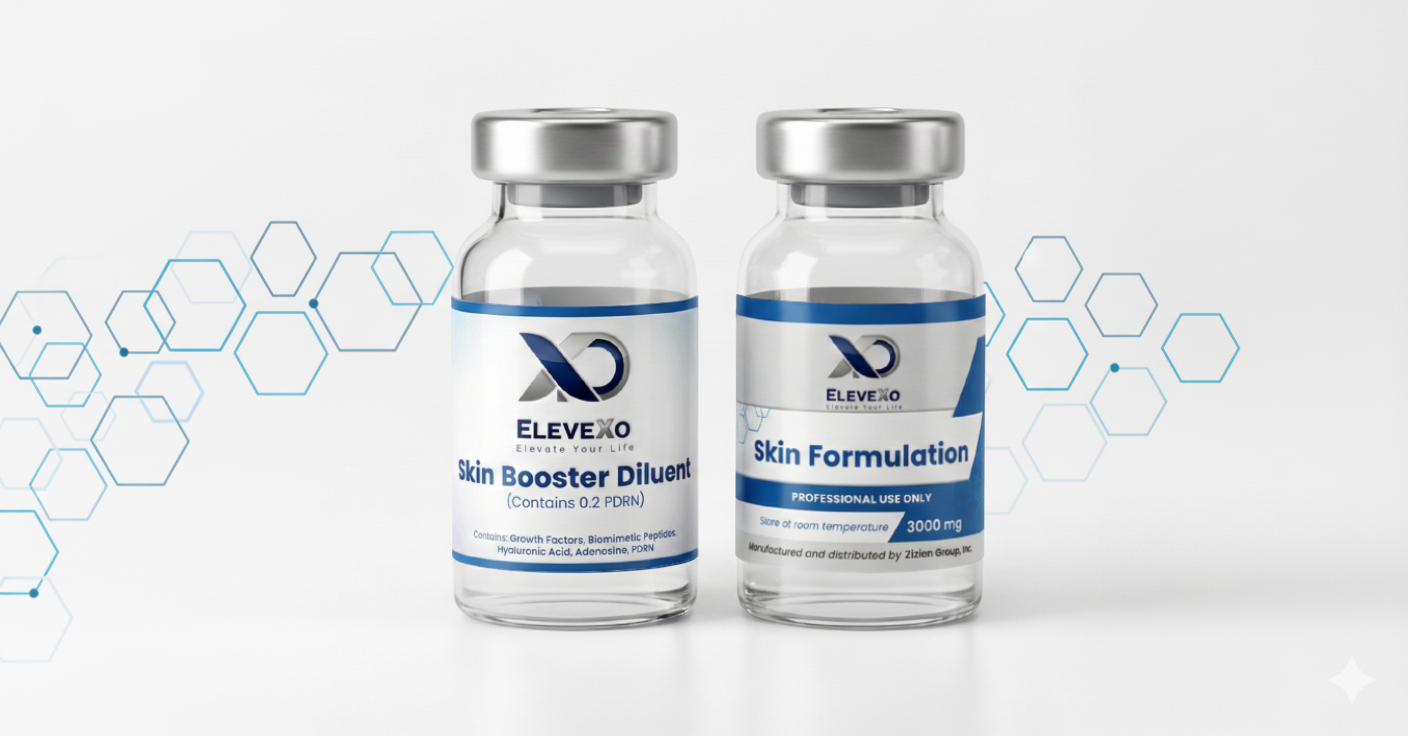
The Science Behind EleveXo S
A decline in cell renewal, collagen production, vascularization, and hydration drives skin aging. EleveXo S addresses these biological mechanisms through a multi-targeted approach:
Growth Factors: Activating Skin Regeneration
Growth factors are proteins that signal skin cells to grow, repair, and regenerate. EleveXo S includes five clinically relevant growth factors:
1. EGF (sh‑Oligopeptide‑1)
Epidermal Growth Factor (EGF) binds to the EGF receptor (EGFR) on keratinocytes and dermal fibroblasts, thereby promoting cell survival, proliferation, migration, and differentiation. Clinical/interface data show topical EGF can accelerate re‑epithelialization, improve skin texture, and reduce signs of ageing. In the context of wrinkle reduction, activating fibroblasts and improving collagen matrix synthesis address one of the core deficits of aged skin. Source.
2. IGF‑1 (sh‑Oligopeptide‑2)
Insulin‑like Growth Factor‑1 (IGF‑1) signaling in skin has been shown to decline with age; lower IGF‑1 is associated with epidermal atrophy and increased keratinocyte damage. By supplying a bio‑mimetic analog of IGF‑1, the formulation supports fibroblast anabolic activity, enhances ECM production, and may improve dermal thickness—key for wrinkle amelioration. Source.
3. VEGFA (sh‑Polypeptide‑9)
Vascular Endothelial Growth Factor A (VEGFA) is essential for angiogenesis and the maintenance of the skin microvasculature; evidence shows that VEGFA signaling enhances nutrient and oxygen delivery, supporting fibroblast viability and extracellular matrix turnover, making it a key target in skin rejuvenation therapies.
4. aFGF (sh‑Polypeptide‑11)
Acidic Fibroblast Growth Factor (aFGF) has been implicated in dermal repair and regeneration in the wound-healing literature; although less direct in aesthetic dermatology, its inclusion supports fibroblast proliferation and collagen/elastin synthesis in synergy with other growth factors.
5. bFGF (sh‑Polypeptide‑1)
Basic Fibroblast Growth Factor (bFGF) similarly acts on dermal fibroblasts, promoting collagen and glycosaminoglycan (GAG) production. Its role in enhancing dermal matrix density complements the overall strategy of restoring skin structural integrity.
Biomimetic peptides are engineered to mimic natural signals for skin repair, reinforcing the formulation's innovative approach to skin regeneration and bolstering confidence in its scientific foundation.
These lab-engineered peptides replicate signals naturally found in the skin, enhancing its ability to repair and rebuild.
GHK-Cu (Copper Tripeptide-1)
A potent skin-regenerating peptide that boosts collagen, elastin, and glycosaminoglycan production. Source.
AHP (Acetyl Hexapeptide-8)
Often referred to as a “topical Botox mimic”, AHP reduces the appearance of expression lines by relaxing facial tension.
Phyto-NEP (Caffeoyl sh-Decapeptide-9)
A plant-derived peptide that enhances skin defense mechanisms and promotes a smoother texture.
Supporting Actives: Optimizing Skin Hydration and Repair
These compounds complement the growth factors and peptides, helping create a healthy environment for regeneration.
Low‑Molecular‑Weight Hyaluronic Acid
Hydration and volume loss are intrinsic to skin ageing: low‑molecular‑weight hyaluronic acid penetrates more deeply, binds water, improves dermal turgor, and creates an optimal milieu for fibroblast activity.
Adenosine
Adenosine interacts with purinergic receptors in the dermis and epidermis, influencing collagen production and microcirculatory tone, and may improve wrinkle appearance in controlled studies.
PDRN (Polydeoxyribonucleotide)
Polydeoxyribonucleotide (PDRN) is a nucleic acid derivative that has been shown to accelerate fibroblast and keratinocyte proliferation, enhance angiogenesis, and improve dermal repair in skin models. Its incorporation provides a “regeneration priming” effect, supporting the actions of growth factors and peptides. Source.
How It Works: A Synergistic Skin Protocol
By combining these components, EleveXo S addresses skin aging through:
- Collagen and elastin production
- Cell turnover acceleration
- Improved hydration and barrier function
- Microcirculation enhancement
- Relaxation of dynamic lines
Who It's For
EleveXo S is designed for use in medical aesthetics settings, including:
- Dermatology and anti-aging clinics
- Med spas with licensed professionals
- Post-procedural skin repair protocols
- Integration with microneedling, RF, or laser treatments
Clinical Use & Application
- Suggested use: Every 14-day application, with or without adjunct procedures
- Visible effects: Improved texture, tone, and hydration typically observed in 4–8 weeks
- Professional guidance recommended
- No systemic claims or permanent outcomes